How long does it take to get to the intralogistics center of an intralogistics system? Alright, yes, I am paraphrasing a bit here, but I had heard that some other intralogistics software producing/using companies had spent several years trying to write a WMS and sort-of gave up because it was harder than they expected.
Likewise, in my own communication with another company, the idea of building a “big” intralogistics platform could only be met with a big organization, a big budget, and a big team, and conversely a big time-frame within which to manage the big asks and big output.
Putting Fred Brooks and Mel Conway aside for the moment – the idea that building a systematic software platform (or the kernel of one at least) takes either an exceptionally long time or an exceptionally large number of people could be empirically challenged is probably considered an act of heresy.
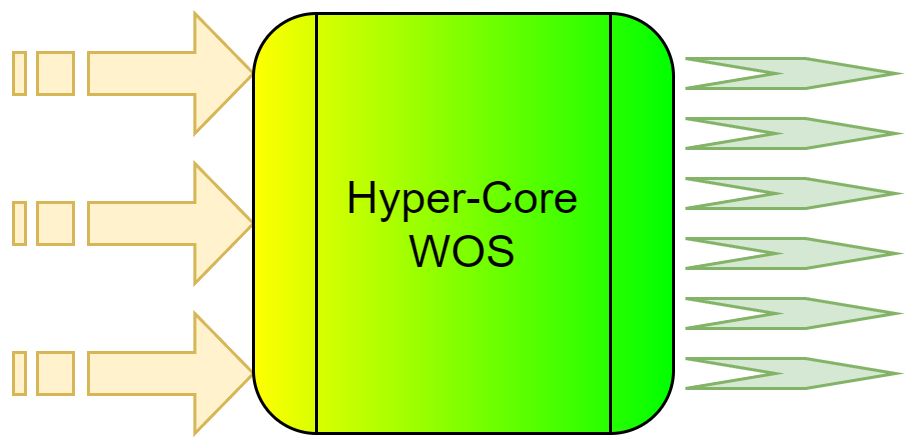
HyperCore is one of several iterations of the intralogistics kernel codebase that presents itself in my company’s marketing and sales literature as a “product” offering (though it’s more of the leveraged base of implementation starting point; or as I term it: a “platform” or operating system) when mounted with WCS/WES hardware and configured with WES/WMS flow process design data.
The following rough timeline is derived from reviewing check-ins across a number of code repositories related to the core platform.
- 3/20/2019 – Core technical setup for main kernel packages (NETCORE 31; after it’s technical footprint, ie, pre-HyperCore)
- 9/30/2019 – moved to GIT and footprints to Docker
- 10/21/2019 – legacy WCS automation library integration started: including shuttles, tote-lifts and conveyors with diverts
- 12/20/2019 – first customer project implementation begun
- 2/1/2020 – 5/1/2021: customer software integration coding
- 7/22/2020 – good-to-person (GTP) sub-system for customer begun
- 8/27/2020 – IS4 security integration started, providing TFA and other OAuth2/OpenId integration points
- 9/16/2020 – main work on IS4 complete
- 1/25/2021 – service-print for on-demand reprint and non-WCS printing begun
- 2/16/2021 – service-print largely complete with basic ZPL processors
- 5/21/2021 – HYPERCORE version fork started: dejunking codebase and improving supportability
- 6/21/2021 – HyperCore base-kernel largely ready
- 7/19/2021 – intralogistics kernel largely ready with fulfillment model created in previous 2 months
- 11/1/2021 – automated put-wall WES integration system started (as a customer one-off)
- 1/12/2022 – automated put-wall largely complete (will be generalized later…)
- 4/23/2022 – StockFlow WES inventory controller “re-“started design and coding
- 9/30/2022 – Stockflow largely complete (built and refined in-line with customer integration as features were needed to support deliverables)
- 11/15/2022 – AUTOFLUX: next gen intralogistics kernel platform beginnings…updating technology, cleaning up pain points from HyperCore
All of the above are those things I had a direct eye and hand in ensuring happened; that is, I’m focusing on the output I know was product focused and how it intermingled with customer implementations; and as an acknowledgement to the other developers in my organization – 4 with a more or less “product-focus” remit, and about a dozen on implementations – I’m not trying to minimize or trivialize the other hard work on fitting, fixing and hammering time-bound solutions into place.
We are now four years out from the start of NETCORE31 (early 2019), and two years out from HYPERCORE (mid 2021). In that time, there was one major customer implementation under NETCORE31, and at least 4 customer implementations (of varying magnitudes) under HYPERCORE.
When I hear that it’s hard (read: impossible) in three years, or that it takes a handful of dozens of organizationally charted developers (I’ll do that math and conservatively equate that to about 60) to deliver a partially productized codebase while also delivering customer projects, my response is typically: you are doing it wrong, and I wish I had at least a fraction of your budget and timeline to burn.
 Hyper-Core Intralogistic Platform