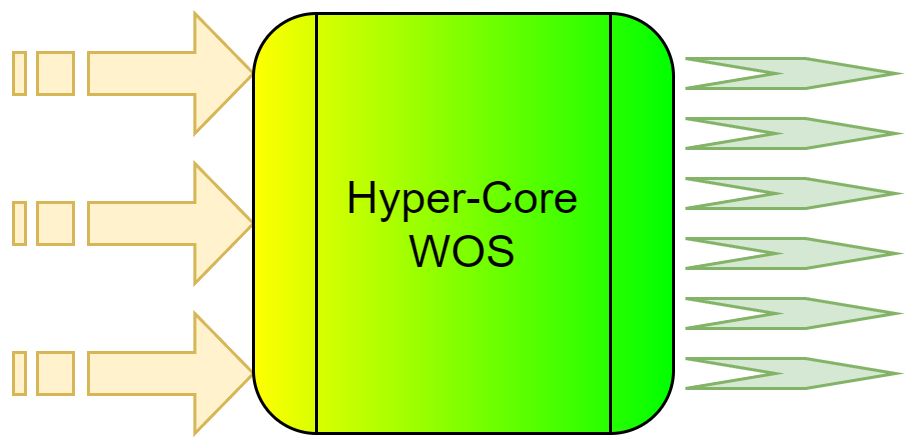
This section describes some basic intralogistic terms and show how HyperCore defines and covers the operational concepts involved with them. This is intended to explain to those without intralogistic experience some of what HyperCore covers, and to explain the nuances of HyperCore’s coverage to those who may be familiar with some of the terms.
Allocations
Allocations are earmarks for inventory to be used in some manner within the warehouse, conventionally for fulfillment or distribution, but also for inventory control operations and maintenance tasks.
HyperCore considers allocations from multiple directions, allowing for fine-grained and flexible allocation strategies:
- Inventory use demands: intent to fulfill specific order-lines, or single-item orders for a specific-SKU
- Inventory reservation provider: tracks stocked inventory by SKU, units per container and number of containers, allowing earmarking ahead of identifying actual containers to engage under the assumption that there may be multiple containers that can cover use
- Inventory provisioning: selecting a specific container from the possible ones to fulfill consumption demands; provisioning can be opportunistic by quantity fit, closeness of inventory pick processor (robot, shuttle or person), availability of other demanded inventory in a partitioned container or shelving unit, aging of the demands and reservations, etc…
- Use consumption: extinguishing a use demand
Warehouse Outbound Profiles
HyperCore has been used in both fulfillment centers and distribution centers.
- Distribution System: Channel or store distribution networks for assembling rolling demands or specific purchase orders.
- Fulfillment System: Direct-ship and in-store fulfillment models have been implemented with HyperCore
Physical Operation Terminology
- Pick: selection of a container from a location for allocated delivery, or selection of inventory piece units from a container for use consumption (typically into another container)
- Put: placement of a container to a location for allocated delivery, or placement of inventory piece units into an “interim” container or location for use consumption
- Pack: placement of inventory piece units into an “outbound” container for completion of warehouse operating demands (i.e., into distribution containers or order packages)
- Move: basic movement of a container from one location to another
- Decant: remove contents from one or more inbound containers and place into one or more pick-friendly containers
Location
Locations have uses defined by their location function and additionally by the zone type the location is situated in. Location functions guide functionality by directing processing logic to look for containers in specific locations by function relative to other locations (within the topology). Locations are the lowest part of a topological hierarchy that includes zones and zone groups (in which zone groups are included in larger zone groups).
Zone Groups are used as operational process-oriented divisions of warehouse space.
Container
Containers are primarily used as inventory holders. They logically be subdivided into compartments. However containers move as a unit, compartments do not. Containers are also used to hold other containers, or hold aggregate inventory quantities that become separate containers when unloaded. Some containers are implicit containers and cannot be moved from the location they occupy, such as with put-wall slots or induction locations where pieces are moved from inventory containers to open space.
Lpn (and other identifiers)
Containers have LPNs (license plate numbers) as a primary identification field used by scanning containers, and can also have additional identifiers within the system. Typically these identifiers are enscribed on the container with barcode labels.
Sku
Stock keeping units identify item unit types (or item masters) within the system. They are generally expected to be tagged with barcodes. UPC and other identifiers are also allowed and an item unit type can have multiple scannable identifiers.
Routing
Routing occurs when scanners and photo-eyes track containers moving on conveyors and divert the containers to different lanes by using PLC I/O to control divert. HyperCore has a standard model for adding custom route logic based on the identification of the container and system interfaces to control routing equipment.
Print/Apply
Print and Apply is used (often in outbound containers, but can be used elsewhere) to affix labels to containers. This is especially useful with shipping labels as part of a packing/manifesting/shipping based fulfillment system. Most of the operational device integration code is similar to routing with the additional steps of printing and verifying (if desired).
Quantity (Quanta and Quantum)
Quantity is a heavily used word in logistics. HyperCore’s StockFlow uses two variations on the term quantity:
- Quantum: indicating the number of units in a reservable container template
- Quanta: the number of reservable compartment/containers holding a particular quantum
In StockFlow parlance, quantity always refers to aggregate units, so 2 quanta of 10 quantum each is a quantity of 20.
 Hyper-Core Intralogistic Platform