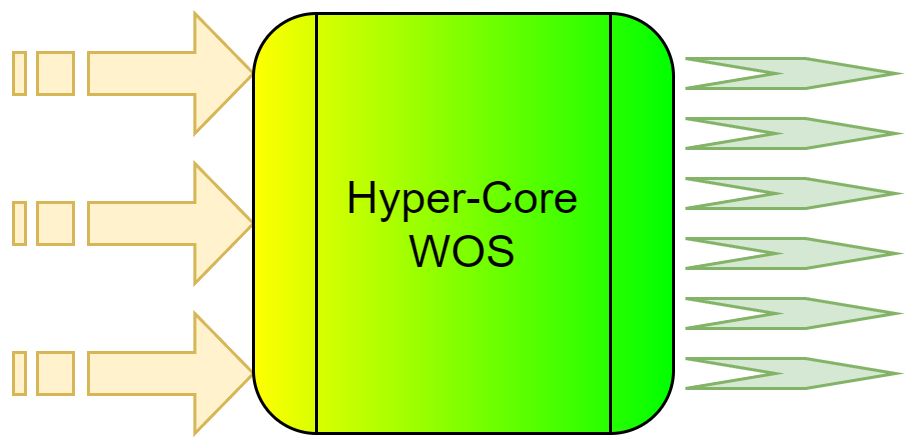
Mapping system concepts to a warehouse is not particularly difficult. The material being “processed” is inventory.
We need only reasonably identify the coverage for the four main determiners of a system: structure, boundaries, functioning and purpose. This next section presents a basic association to them.

Structure
The physical structure of a warehouse should be materially obvious. The warehouse can be analyzed as a set of sub-components, whose logical purpose in the larger system line up with the usual intralogistical functions:
- receiving docks
- loading docks
- areas to decant inventory from inbound to warehouse containers
- storage locations to hold inventory until needed
- packing areas to divide or aggregate inventory into other containers for outbound
- control and exception areas to inspect and process
Depending on how inventory moves physically through the warehouse, there may be networks of conveyors, dedicated travel aisles for people or robots, automation equipment to placing and/or retrieving inventory from storage racks, unit sorters in various forms that move individual pieces automatically, and large overhead automated cranes.
Boundaries
A warehouse is an open system that exchanges energy and matter with that which is not in the warehouse.
A warehouse exchanges energy (consumes power and emits heat as a by-product), takes in material deliveries and sends out material shipments. HyperCore is currently focused on the material flow of inventory within the warehouse and was built with affordances for the two primary boundaries for material flow within the warehouse: inbound (or receiving) and outbound (i.e., the loading dock).
Functioning
The primary mode of functioning within the intralogistic warehouse is the movement of inventory from inbound to outbound. Usually these are in containers that logically can be identified as having quantities of item units, and tagged with external identifiers that allow for logical tracking and accounting of the inventory.
The subsidiary forms of movement consist of the following:
- Moving inventory by moving containers between locations
- Moving pieces of inventory between containers (or between compartments of multi-compartment containers)
- Adding inventory to containers: such as during receiving or while performing inventory control operations
- Removing inventory from containers: while performing inventory control operations
- Removing containers, either because they are empty, or because they and their inventory are no longer considered to be in the system (outbound and shipped)
Purpose
Each warehouse may have a different purpose dependent on the external organizational needs of the warehouse operators. Typical examples include:
- Fulfillment center: where customer orders are assembled from received and stored inventory
- Distribution center: where supplier shipments are repartitioned for channel and store shipments
- Mixed-use: in-store fulfillment and self-serve “reserve” restock
 Hyper-Core Intralogistic Platform